


Control Effectiveness
Achieve greater safety, efficiency and
productivity by harnessing frontline
expertise in critical control design
Industries that have benefited from Control Effectiveness
-
![]()
Manufacturing
-
![]()
Aerospace
-
![]()
Mining
-
![]()
Defence
-
![]()
Construction




Verifiable, Defensible, Operationally Reliable Controls
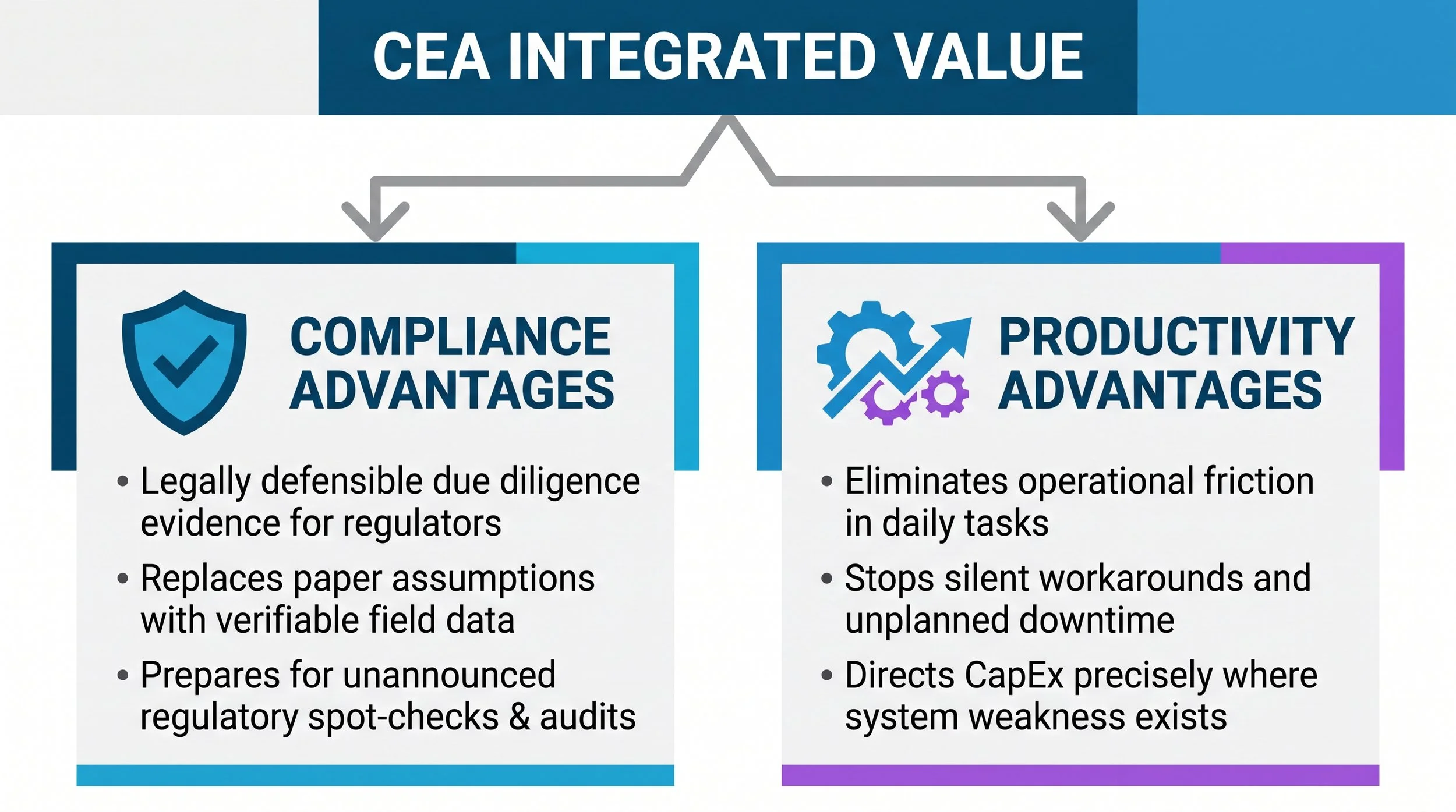
The material benefit of adopting Control Effectiveness Assessment (CEA) for executive leadership is that it replaces the false assurance of paper-based compliance with verifiable, legally defensible, and operationally reliable risk intelligence. Instead of leaving executives vulnerable to unseen operational failures, CEA delivers value across several core areas:
Defensible Legal Due Diligence Protection
Overcomes the "Activity Count" Legal Defect: Judicial precedents, such as Maritime New Zealand v Gibson (Ports of Auckland), established that activity counts, audit completion rates, and dashboards of "green ticks" do not legally discharge an officer’s due diligence obligations.
Reasonably Practicable: Australian WHS legislation and mining regulations (such as Queensland’s RSHQ Critical Control Management framework) demand proof that controls hold up under live operating conditions. CEA provides an auditable, traceable evidence trail demonstrating that leadership understands operational reality, has identified points of control fragility, and has allocated appropriate capital to remediate them.
Liability Management: By moving beyond reliance on WHS managers’ binary reports, officers can demonstrate active verification of control performance, directly fulfilling the statutory mandates to Know, Understand, Resource, Monitor, Comply, and Verify.
Elimination of the "Green Tick" Illusion
Unmasks Silent Degradation: In traditional risk registers, administrative controls (like a permit or procedure) are often marked as "effective," giving the board an illusion that residual risk is low or very low.
Exposes the Administrative Control Fallacy: As demonstrated by the Brady Review into fatal mining incidents, organisations lacking qualitative diagnostic data default to low-tier administrative controls 62% of the time. CEA differentiates true hard controls (elimination, substitution, engineering systems that arrest damaging energy) from control supports (training, procedures, PPE), ensuring executives do not rely on unreliable human performance to manage fatal risks.
Capital & Resource Allocation
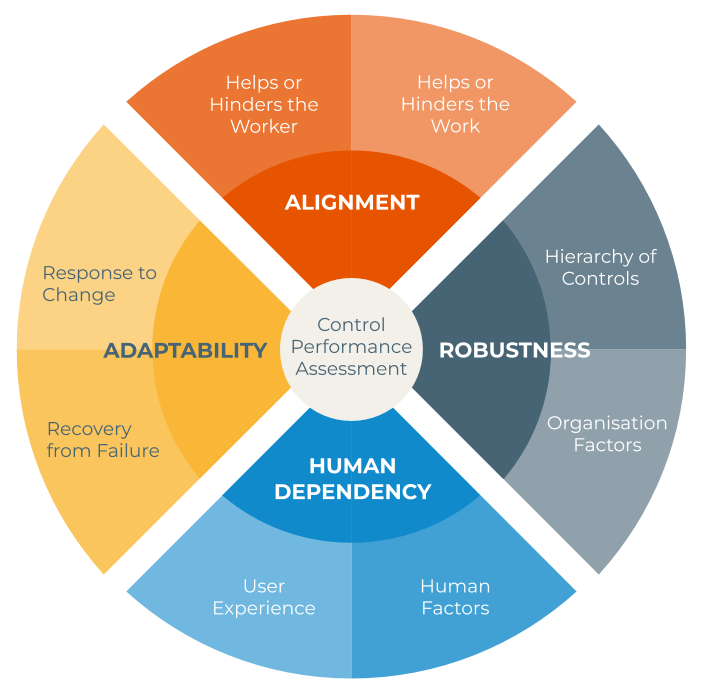
Targeted Interventions: By breaking control reliability into four distinct quadrants (Robustness, Human Dependency, Alignment, Adaptability), CEA establishes the failure mode:
Low Robustness: Directs capital toward hard control strategies.High Human Dependency: Highlights where workers are cognitively overloaded or fatigued, pointing to automation or staffing adjustments.
Low Alignment: Reveals tooling or ergonomic friction that needs immediate remediation to prevent dangerous workarounds.
Low Adaptability: Shows where controls fail during night shifts, bad weather, or contractor transitions.
Prevents Wasteful Initiatives: Helps executives shift from repeatedly funding retraining or procedure rewrites that fail to improve reliability.
Early-Warning Leading Indicators (Operational Drift)
Captures Weak Signals Before Material Unwanted Events: Investigation teams often find after a catastrophic event that frontline teams had been working around a control for months.
Workforce as a Distributed Sensor Network: CEA turns frontline workers into a sensor network by gathering real-world data on Work-as-Done (WAD) versus Work-as-Intended (WAI). Tracking CEA scores over time provides a quantifiable trend that detects operational drift—allowing leadership to intervene before an energy breach or fatality occurs.
Alignment of Safety Velocity with Commercial Productivity
Elimination of Operational Friction: Traditional compliance often imposes bureaucracy that slows down work delivery. When controls are evaluated for Alignment, leadership learns whether a control facilitates or hinders the work.
Removal of the Incentive to Cut Corners: When controls are redesigned to fit the natural flow of work, production bottlenecks and workarounds disappear simultaneously, driving both compliance and operational efficiency.
The benefits to you:
Leadership
Develop a clear understanding of work as done
Gain greater insight into the nature and performance of critical controls
Develop insightful governance questions for leadership, operations, experts and frontline people
Ensure confidence in your control strategy and control effectiveness
Know your due diligence obligations are properly met.
Operations
Better understand and effectively manage human dependency on controls
Ensure controls are designed to facilitate safety, reliability and productivity for people who do the work
Contribute to continuous improvement of control design
Remove Safety Clutter and poor productivity
Improve communications on control design and effectiveness to management.
AUSIMM International Mine Health and Safety Conference 2026 - Awarded Best Paper